

Golden, flaky, and soaked in fragrant syrup, baklava is not just a dessert—it’s a dish of culture and history. Bite into a square of this luscious treat and you’re tasting centuries of tradition, passed down through generations and shaped by empires, trade routes, and evolving palates.
Baklava’s precise origin remains a topic of delicious debate. Some believe it dates back to the Assyrians, who layered nuts between thin sheets of dough and drenched the result in honey as early as the 8th century BCE. Others credit the Ottoman Empire with refining baklava into the intricate, buttery pastry we know today. What’s certain is that baklava has travelled far and wide, becoming a cherished delicacy in Greece, Turkey, the Middle East and across the Balkans.
At first glance, baklava might seem like a simple dessert. Layers of filo pastry are stacked with chopped nuts—often walnuts, pistachios, or almonds—and baked until crisp. Then comes the magic touch: a hot syrup, usually infused with lemon, rosewater, or orange blossom, is poured over the fresh pastry, soaking into every flaky crevice. The result is a delicate balance of crunch and chew, sweet and nutty, rich yet surprisingly light.
Baklava’s true beauty lies in its variety. Each region has its own twist on the classic. In Turkey, you’ll often find baklava made with pistachios from Gaziantep, considered some of the finest in the world. Greek baklava tends to feature walnuts and a hint of cinnamon, giving it a warm, spicy note. In Lebanon and Syria, orange blossom water lends a floral aroma to the syrup. There are even modern versions using chocolate, dried fruits, or different shapes—like rolled or triangular baklava—to add flair and novelty.
Traditionally, Ottoman baklava is reserved for special occasions. It’s a favourite during religious festivals like Eid and Christmas, and is often served at weddings, family gatherings, and community celebrations. Making Ottoman baklava at home is considered an act of love and patience, as laying each paper-thin sheet of filo demands a steady hand and attention to detail.
Whether enjoyed with a cup of strong coffee or as the grand finale to a festive meal, baklava remains a treasured delight—an edible link between past and present, east and west, tradition and innovation.
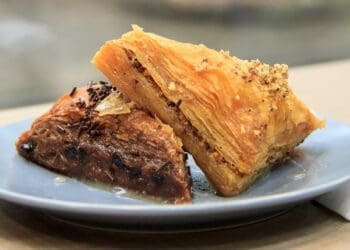
Ottoman Baklava
Ingredients
Pastry Ingredients:
- 250 g unsalted butter melted
- 400 g filo pastry about 20 sheets
- 300 g mixed nuts walnuts, pistachios, almonds finely chopped
- 1 tsp ground cinnamon
Syrup Ingredients:
- 250 g granulated sugar
- 200 ml water
- 150 g honey
- 1 tbsp lemon juice
- 1 tsp rosewater or orange blossom water optional
Instructions
- In a bowl, mix the finely chopped nuts with the ground cinnamon. Set aside.1 tsp ground cinnamon, 300 g mixed nuts
- Preheat your oven to 180°C (160°C fan) / 350°F / Gas Mark 4.
- Brush a 30x20cm (12×8 inch) baking dish with melted butter.250 g unsalted butter
- Place one sheet of filo in the dish, brush with butter, and repeat for 10 sheets.400 g filo pastry
- Spread half the nut mixture evenly over the pastry.300 g mixed nuts
- Add 5 more sheets of filo, buttering each one, then layer the remaining nuts.300 g mixed nuts
- Top with the remaining 5 filo sheets, buttering each one generously.
- Using a sharp knife, cut the baklava into diamond or square shapes, cutting all the way through the layers.
- Bake in the preheated oven for 40–45 minutes, or until golden and crisp.
- While the baklava bakes, combine sugar, water and lemon juice in a saucepan. Bring to a boil, reduce to a simmer, and cook for 10 minutes. Stir in the honey and optional rosewater or orange blossom water. Simmer for 5 more minutes, then remove from heat.250 g granulated sugar, 200 ml water, 1 tbsp lemon juice
- Stir in the honey and optional rosewater or orange blossom water. Simmer for 5 more minutes, then remove from heat.150 g honey, 1 tsp rosewater
- Once the baklava is out of the oven, immediately pour the hot syrup evenly over the entire surface. Let it soak for at least 4 hours, preferably overnight, before serving.
14 comments
I love the contrast between the crunchy filo and the soft, syrupy centre.
One piece never feels like enough.
So worth the time it takes to make. Each bite is a burst of buttery pastry and spiced nuts.
This baklava tasted like the ones from my grandmother’s kitchen.
Very good, but next time I’d reduce the syrup just a little.
The layers were perfectly crisp and buttery, and the syrup was just the right balance of sweet and floral.
I’d never made baklava before, but this recipe made it feel achievable. It took a bit of effort, but the end result was incredible—crunchy, nutty, and soaked in delicious syrup.
Never thought I’d enjoy something this sweet, but it won me over.
My son made this and very sweet, it was delicious
It’s a luxurious dessert that looks and tastes impressive.
This baklava had a lovely homemade quality. While not quite as rich as the traditional versions here, it still hit the mark with flavour and texture.
I took this to a family get together and it disappeared in minutes. Everyone kept asking where I bought it from. That’s how good it was.
t’s got crunch, warmth, and that irresistible sticky finish.
I added extra walnuts and a pinch of clove—just like my mother used to.